
Waterproof Basin Cabinet Materials:
PVC vs Stainless Steel vs Plywood
An honest comparison of PVC, stainless steel and plywood basin cabinet materials for humid Singapore bathrooms, plus the boards to avoid.
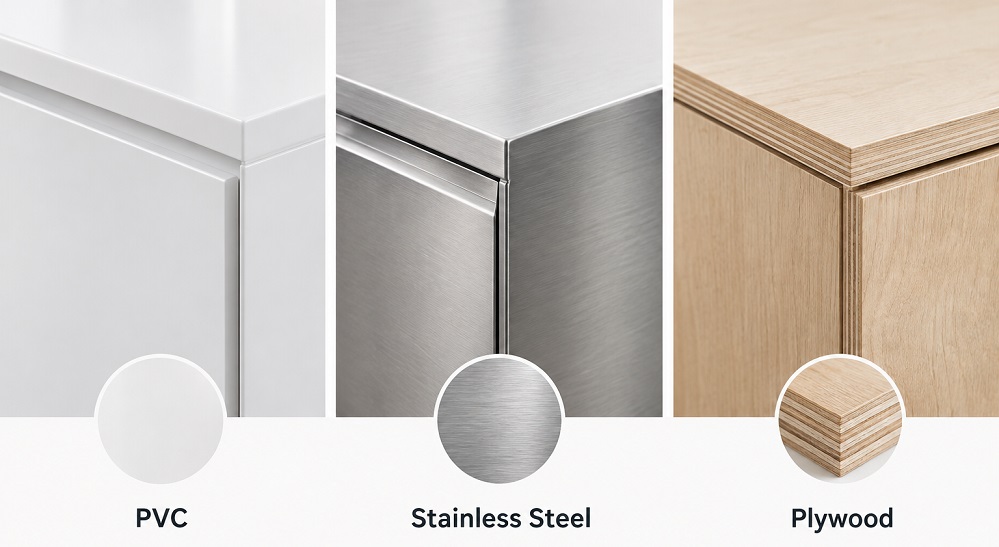
- Why humidity and splashes ruin the wrong cabinet material
- PVC basin cabinets: fully waterproof & highly popular
- Pros
- Cons
- Stainless steel basin cabinets: ultra-durable & sleek
- Pros
- Cons
- Plywood & marine plywood: a natural wood option (with caveats)
- Pros
- Cons & real trade-offs
- Warning: avoid ordinary MDF, chipboard, and solid wood in wet zones
- Wall-hung vs floor-standing cabinets
- How to spot a genuinely water-resistant cabinet
- Comparison table: cabinet materials
- Frequently asked questions
- Is a PVC basin cabinet durable enough for daily family use?
- Can I install a mirror cabinet made of the same material?
- How do I fix swollen cabinet edges if water gets in?
- Does a waterproof cabinet require special cleaning products?
- Ready to upgrade your bathroom vanity?
If you have ever lived in an older HDB flat, you have probably seen it: a bathroom vanity cabinet with peeling laminate, swollen edges, or a sagging floor board. Singapore's year-round relative humidity (often hovering between 70% and 90%) combined with daily shower steam and tap splashes creates a harsh environment for indoor furniture.
Choosing the right material for your basin cabinet is the single most important factor in determining how long your vanity will last. Pick the wrong board, and moisture will cause it to swell, rot, and harbour mould within a few short years.
This guide breaks down the most reliable waterproof and water-resistant materials for Singapore bathrooms, compares PVC, stainless steel, and plywood honestly, and highlights what red-flag materials you must avoid.
Why humidity and splashes ruin the wrong cabinet material
Bathroom cabinets face two distinct moisture threats in Singapore homes:
- Ambient moisture & steam: high humidity and hot shower steam seep into unsealed cabinet edges, causing internal wood fibres to expand, twist, and delaminate over time.
- Direct water splashes: water splashing from the wash basin or pooling on the bathroom floor during weekly cleaning quickly destroys porous core boards if there is no waterproof barrier.
To survive these conditions, a vanity material needs to either be completely non-porous or built from tightly bound, water-resistant layers sealed with waterproof glues.
PVC basin cabinets: fully waterproof & highly popular
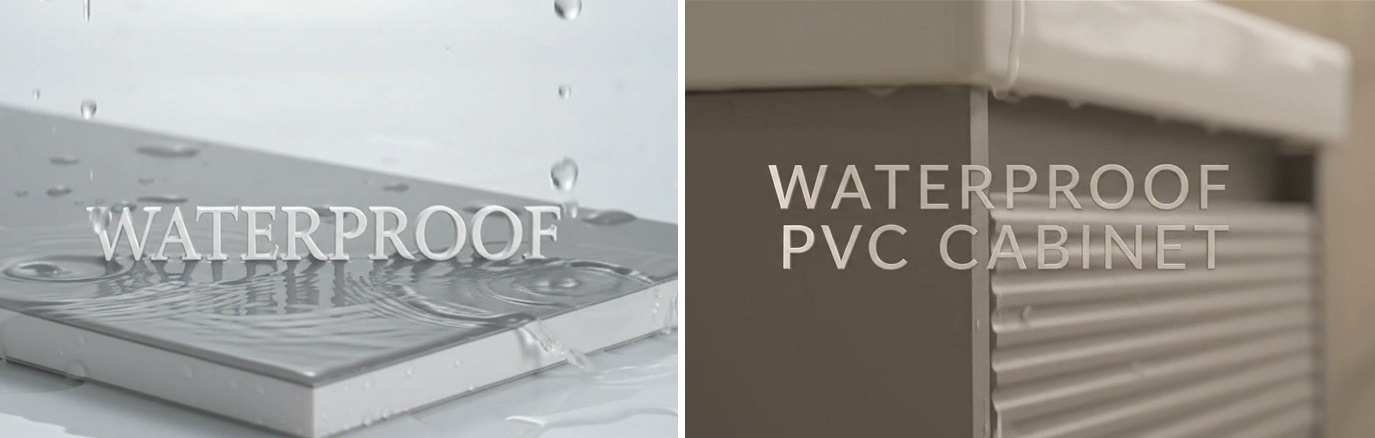
PVC (polyvinyl chloride) foam board has become the go-to material for modern HDB, BTO, and condo bathroom vanities. Unlike wood, PVC is a synthetic plastic material, making it 100% waterproof.
Pros
- 100% waterproof: PVC cannot absorb water, swell, warp, or rot, even if submerged or exposed to continuous steam.
- Termite and mould proof: because it contains zero wood fibre, pests like termites will not touch it, and mould cannot penetrate the board core.
- Lightweight and versatile: easy to mount securely onto HDB concrete walls as a floating unit, available in smooth matte finishes or textured wood-grain laminates.
- Highly affordable: delivers exceptional long-term value for Singapore homeowners looking for worry-free durability without breaking the bank.
Cons
- Lower load-bearing capacity: PVC boards are less dense than solid wood or heavy metal. Very heavy stone countertops require internal support framing or thicker PVC structural panels.
- Susceptible to extreme heat: while fire-retardant, prolonged exposure to high heat sources can warp PVC (though this is rarely an issue in a standard bathroom).
Stainless steel basin cabinets: ultra-durable & sleek
Stainless steel bathroom cabinets offer an industrial-strength alternative that handles wet environments effortlessly.
Pros
- Completely impervious to water: steel will never swell, delaminate, or absorb moisture, making a stainless steel bathroom cabinet virtually indestructible in wet zones.
- High structural strength: can easily support heavy stone counter slabs, double basins, or thick ceramic tops without sagging.
- Sleek, modern aesthetic: delivers a clean, contemporary appearance that pairs exceptionally well with modern minimalist or industrial interior styles.
Cons
- Prone to water spots and fingerprints: matte or metallic finishes can show water spots, soap residue, and fingerprints, requiring regular wiping to look pristine.
- Metallic sound profile: cabinet doors can produce a hollow metallic clack when closing if high-quality soft-close hinges or rubber dampening pads are not installed.
Plywood & marine plywood: a natural wood option (with caveats)
High-grade plywood is made by gluing cross-grained wood veneers together under high pressure. When crafted correctly, a solid plywood vanity provides a natural, sturdy feel.
Pros
- Strong screw-holding power: holds heavy-duty drawer runners, hinges, and mounting brackets exceptionally firmly.
- Excellent structural rigidity: resists bending and handles heavy stone tops with ease.
- Warm, natural aesthetic: ideal for homeowners who prefer real wood textures and warm laminate veneers.
Cons & real trade-offs
- Not 100% waterproof: standard interior plywood is water-resistant, not waterproof. If water penetrates behind unsealed edge banding or around plumbing cut-outs, the inner plies can eventually absorb moisture and swell.
- Requires quality sealing: for reliable performance, ensure the cabinet uses marine-grade or high-moisture-resistant (HMR) plywood sealed with solid ABS edge banding. Cheap, low-grade plywood will struggle in humid Singapore bathrooms.
Warning: avoid ordinary MDF, chipboard, and solid wood in wet zones
To build a vanity that lasts, it is just as important to know what materials not to buy.
Honest warning: always avoid vanity cabinets made from ordinary MDF (medium-density fibreboard), particle board / chipboard, or unsealed solid wood.
- MDF and chipboard: made from compressed sawdust and paper fibres held by glue. Once exposed to humidity or a small pipe leak, they act like a sponge, expanding into flaky, unsalvageable mush that cannot be repaired.
- Solid wood: while luxurious in living rooms, raw solid timber expands and contracts dramatically with temperature and humidity shifts, leading to cracked joints and sticking cabinet doors in a tropical bathroom.
Wall-hung vs floor-standing cabinets
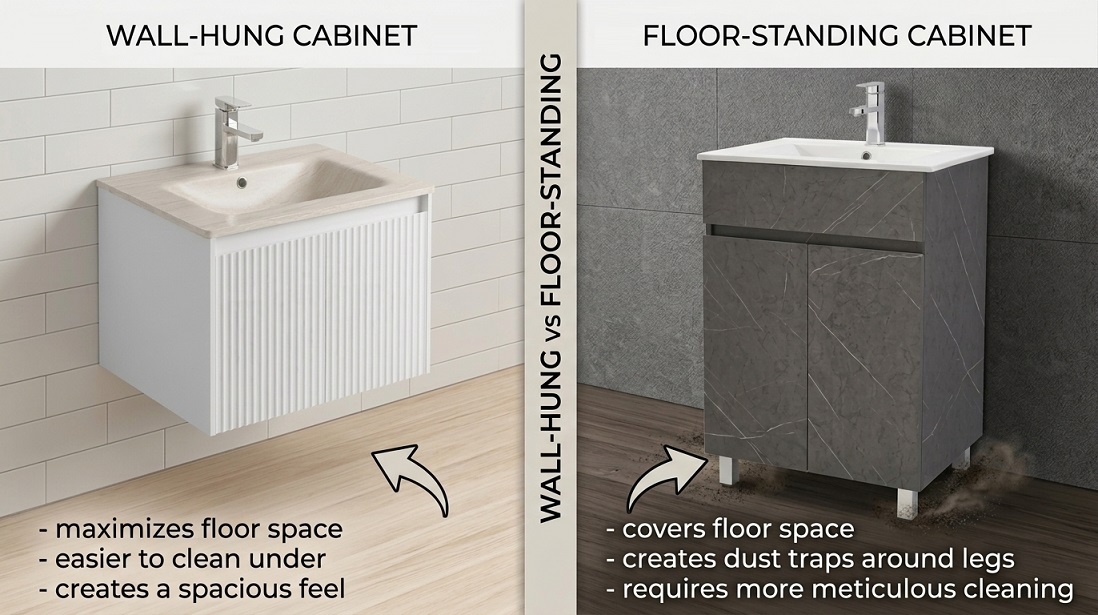
When picking your cabinet layout, keep floor contact in mind. Floating wall-hung vanities keep the cabinet base completely clear of standing floor water, while floor-standing models require protective levelling feet. For a complete guide on vanity sizes, layouts, and placement, read How to Choose the Right Bathroom Vanity.
How to spot a genuinely water-resistant cabinet
A waterproof cabinet body is only half the battle. To ensure the entire unit withstands daily use, inspect these hardware details:
- Stainless steel or aluminium fittings: look for cabinet handles, drawer tracks, and mounting brackets made from rust-proof stainless steel or anodised aluminium.
- Stainless steel soft-close hinges: standard cheap iron hinges rust quickly in damp bathrooms, leaving brown stains down the cabinet doors. Quality vanities use Grade 304 stainless steel soft-close hinges.
- Seamless ABS edge banding: inspect the cabinet edges. Thick, machine-applied ABS (acrylonitrile butadiene styrene) edge banding seals the board core completely against steam and standing water.
Comparison table: cabinet materials
| Material | Waterproofing level | Weight | Aesthetic style | Best for |
|---|---|---|---|---|
| PVC board | 100% waterproof | Lightweight | Versatile (matte, colours, wood-grain) | HDB/BTO bathrooms, budget-friendly durability, zero maintenance |
| Stainless steel | 100% waterproof | Heavy | Sleek, modern, metallic / matte | Industrial designs, heavy counter tops, maximum lifespan |
| High-grade plywood | Water-resistant (requires sealing) | Medium | Warm wood tones & textures | Luxury master bathrooms with good ventilation |
| MDF / chipboard | Poor (not water-resistant) | Medium | Cheap laminates | Avoid in bathrooms (swells easily) |
Frequently asked questions
Is a PVC basin cabinet durable enough for daily family use?
Yes. High-density PVC foam board is surprisingly rigid and completely immune to water rot, termites, and steam. When fitted with quality hardware and soft-close hinges, a PVC basin cabinet offers one of the most practical, low-maintenance options for Singapore homes.
Can I install a mirror cabinet made of the same material?
Absolutely. Pairing a waterproof vanity with matching Mirrors & Mirror Cabinets made from PVC or water-resistant materials gives you cohesive vertical storage for toiletries while protecting your wall fixtures from shower steam.
How do I fix swollen cabinet edges if water gets in?
Unfortunately, once internal wood boards (like chipboard or MDF) absorb water and swell, the wood fibres burst permanently and cannot shrink back to their original flat shape. The affected panels or the entire cabinet will eventually need replacement, which is why choosing PVC or high-grade plywood from the start is essential.
Does a waterproof cabinet require special cleaning products?
No. PVC and stainless steel cabinets can be cleaned easily using warm water, a mild dishwashing detergent, and a soft microfibre cloth. Avoid harsh abrasive scouring pads or strong acidic chemicals, as these can scratch surface laminates or protective metal coatings.
Ready to upgrade your bathroom vanity?
Explore our durable, humidity-proof collection of quality Basin Cabinets designed specifically to handle Singapore's tropical climate.

Product tips and buying guides from the SG Appliances team.