
Built-In Oven Buying Guide for Singapore Kitchens
How to choose a built-in oven in Singapore: 60cm vs 45cm, capacity in litres, cooking functions, self-cleaning, and electrical and cabinet requirements.
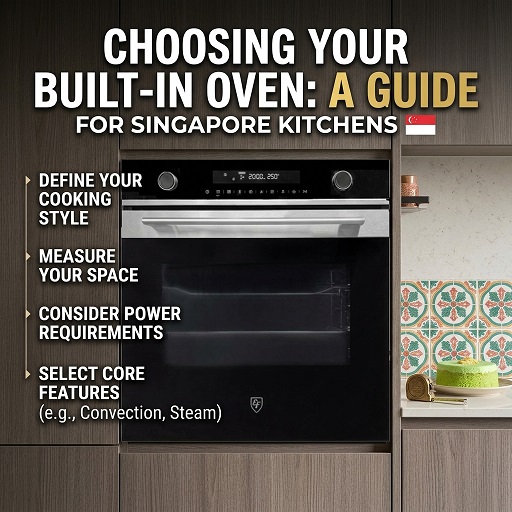
- Quick answer
- Built-in vs freestanding vs benchtop oven
- Built-in oven
- Freestanding oven
- Benchtop oven
- Choosing the right oven size
- 60cm built-in oven
- 45cm compact oven
- Capacity in litres: what does it mean?
- Oven functions: what do you actually need?
- Conventional heating
- Fan or convection cooking
- Grill
- Multifunction oven
- Self-cleaning ovens
- What about steam ovens?
- Electrical requirements in a Singapore kitchen
- Cabinet housing and ventilation
- Which oven suits your cooking style?
- For the keen baker
- For regular family cooking
- For occasional oven users
- Oven function comparison
- FAQ
- Is a 60cm or 45cm built-in oven better for a Singapore kitchen?
- How many litres should a built-in oven have?
- Does a built-in electric oven need a special electrical connection?
- Can I put any built-in oven into my kitchen cabinet?
- Final thoughts
Quick answer
For most Singapore kitchens, a 60cm built-in oven is the standard choice if you bake, roast or cook regularly and have enough cabinet space. A 45cm compact built-in oven can make better use of a smaller kitchen or suit a household that needs a smaller cooking cavity. When choosing, look beyond size and consider the oven's capacity in litres, cooking functions, cleaning system, electrical requirements and cabinet installation. If you only use an oven occasionally, a simpler model may be all you need.
Built-in vs freestanding vs benchtop oven
Before choosing a model, it helps to understand the different oven formats.
Built-in oven
A built-in oven is installed into kitchen cabinetry, either below the worktop or in a tall cabinet at a more convenient height.
This gives the kitchen a neat, integrated appearance and allows the oven position to be planned around the rest of the kitchen.
A built-in oven can also be installed at eye or chest level, making it easier to check food and handle hot trays without repeatedly bending down.
Best for: new kitchens and renovations where the cabinetry can be designed around the appliance.
Freestanding oven
A freestanding oven combines the oven and hob in one appliance.
It can be practical when you want a single cooking appliance without creating a separate built-in oven cabinet.
Best for: homeowners who prefer a conventional cooker arrangement or are not planning a fully integrated kitchen appliance layout.
Benchtop oven
A benchtop oven sits on the kitchen worktop rather than being installed into cabinetry.
It can be useful where cabinet space is limited or where you do not want permanent built-in installation.
Best for: occasional cooking, smaller kitchens or households that need a more flexible setup.
SG Appliances carries both built-in ovens and freestanding ovens, so the choice can be based on your kitchen layout and how you use the oven.
Choosing the right oven size
For built-in ovens, two sizes are particularly useful for Singapore kitchens.
60cm built-in oven
A standard built-in oven is commonly around 60cm wide and 60cm high. This is the familiar full-size format for a built-in kitchen oven.
It gives you a larger cooking cavity and is a sensible choice if you regularly:
- Bake cakes, bread or pastries
- Roast meat or poultry
- Cook larger dishes
- Prepare food for several people
- Use multiple shelves or trays
Capacity is measured in litres, and two ovens with similar external dimensions can still have different internal capacities.
If you bake regularly, look at the actual litre capacity and usable interior space rather than choosing solely by external dimensions.
45cm compact oven
A compact built-in oven is typically around 45cm high, while remaining about 60cm wide.
This can be particularly useful in a compact HDB or BTO kitchen where cabinet space is limited.
A smaller physical size does not necessarily mean that the oven has only basic functions. Some compact models are available with multiple cooking modes and other features.
Best for: smaller households, compact kitchens and homeowners who do not regularly need a large oven cavity.
The important question is whether the oven's litre capacity is enough for the dishes you normally cook.
Capacity in litres: what does it mean?
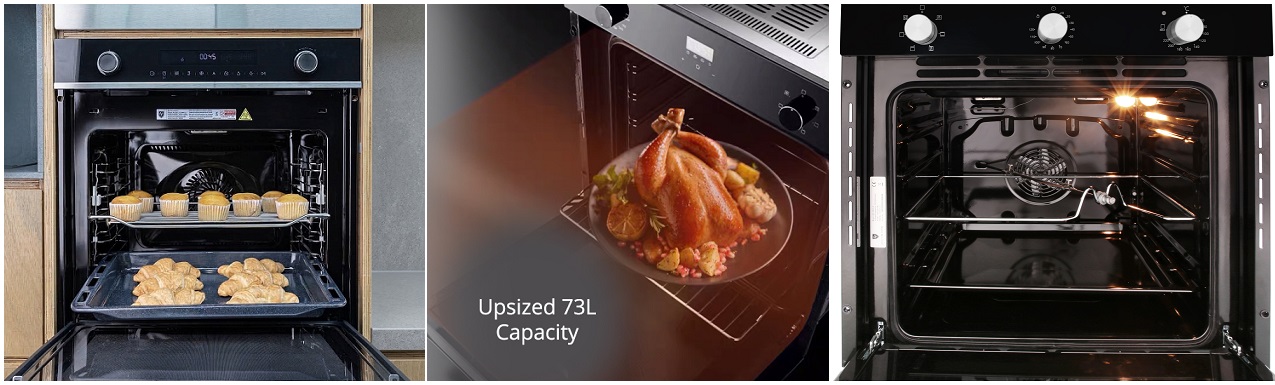
Oven capacity tells you how much space is available inside the cooking cavity.
A larger capacity can make it easier to cook larger roasting dishes or multiple items, while a smaller cavity may be perfectly adequate for everyday meals.
Think about the dishes you actually use.
If you regularly roast a large chicken, bake several trays of food or cook for a larger household, you will probably appreciate a larger cavity.
If you mainly bake small cakes, heat prepared food or cook simple meals for one or two people, a compact oven may be sufficient.
Do not assume that the biggest oven is automatically the right choice. A larger cavity also needs more cabinet space.
Oven functions: what do you actually need?
Ovens can have anything from a few basic functions to a long list of specialised programmes. More functions are useful only if you will actually use them.
Conventional heating
Conventional heating uses heating elements to provide heat from the top and bottom.
It is suitable for everyday baking and roasting, particularly when cooking on one level.
Best for: occasional baking, roasting and straightforward oven cooking.
Fan or convection cooking
A fan circulates hot air inside the oven, helping distribute heat more evenly.
This can be useful when cooking or baking on more than one level, depending on the oven design and programme.
Best for: regular baking, roasting and homeowners who want more flexible cooking across the oven cavity.
Grill
A grill uses strong heat from the upper part of the oven.
It is useful for browning food, grilling sausages or meat, making toast and finishing dishes with a crisp surface.
Best for: browning, grilling and finishing dishes.
Multifunction oven
A multifunction oven combines several heating methods, such as conventional heating, fan cooking and grilling.
Some models provide additional programmes for specific cooking tasks.
Best for: homeowners who bake and cook regularly and want greater flexibility.
However, do not choose an oven simply because it advertises many functions. Focus on the functions you are likely to use.
Self-cleaning ovens
Self-cleaning systems can make oven maintenance easier.
Pyrolytic cleaning uses very high temperatures to break down grease and food residue inside the oven. After the cycle has cooled, the remaining residue can be wiped away.
Catalytic cleaning uses specially treated surfaces inside the oven to help break down grease during cooking.
The two systems work differently. Pyrolytic cleaning is a dedicated high-temperature cleaning cycle, while catalytic surfaces help reduce grease build-up during normal use.
If you roast or grill frequently, a self-cleaning system can be more useful than it is for someone who only uses the oven occasionally.
What about steam ovens?
Steam ovens add steam cooking to the usual oven functions.
Steam can be useful for foods such as vegetables, fish and some baked goods. Some ovens combine steam with conventional or fan cooking rather than being purely steam-only appliances.
For most homeowners, steam is an additional feature rather than an essential requirement. Consider it if you already know you will use steam cooking regularly.
Electrical requirements in a Singapore kitchen
A built-in electric oven can have significant electrical requirements, so this should be considered before the kitchen cabinets are finalised.
Depending on the appliance, a built-in oven may require a dedicated electrical point or higher-rated circuit rather than simply using an ordinary socket.
Do not assume that an existing kitchen power point is suitable.
For an HDB or BTO renovation, ask your qualified electrician to check the home's wiring, circuit capacity and the electrical requirements of the specific oven you intend to install.
The oven's installation instructions should always take priority because electrical requirements can vary between models.
Cabinet housing and ventilation
A built-in oven does not simply sit inside an empty cabinet.
The housing needs to be constructed to the oven manufacturer's specified dimensions, including the required width, height and depth of the installation opening.
There also needs to be suitable ventilation and clearance around the appliance. The exact requirements vary by model, so the installation drawing for the oven should be given to the kitchen contractor before the cabinet is built.
This is particularly important if you are choosing between a 60cm and 45cm oven.
Do not build the cabinet based only on the oven's external dimensions. The manufacturer's installation diagram may specify additional clearances, ventilation openings and other requirements.
For example, a compact oven may fit into a different cabinet arrangement from a standard 60cm oven.
Which oven suits your cooking style?
For the keen baker
If baking is an important part of your cooking, look for:
- A suitable full-size cooking cavity
- Fan or convection cooking
- Good temperature control
- Multiple shelf positions
- Grill function
- Useful baking accessories
- A cleaning system that matches how frequently you bake
A 60cm built-in oven will generally give you more room to work with than a compact oven.
For regular family cooking
If you roast meat, bake occasionally and prepare meals for several people, a multifunction 60cm oven can provide useful flexibility.
You may not need every specialised cooking programme. Concentrate on the basic heating functions, capacity and cleaning system that you will actually use.
For occasional oven users
If you only use an oven occasionally for reheating, simple baking or roasting, a basic conventional or fan-assisted oven may be enough.
There is little benefit in choosing a highly featured oven if most of those functions will remain unused.
A compact 45cm oven can also make sense where kitchen space is limited, provided its capacity suits your cooking needs.
Oven function comparison
| Function level | What you typically get | Suitable for |
|---|---|---|
| Basic conventional | Top and bottom heating, simple controls | Occasional cooking and basic baking |
| Fan/convection | Conventional cooking plus circulating hot air | Regular baking and roasting |
| Grill + fan | Grill plus circulated heat | Roasting, browning and grilling |
| Multifunction | Several heating methods and programmes | Keen cooks and regular family cooking |
| Self-cleaning | Cooking functions plus pyrolytic or catalytic cleaning | Frequent users who want easier maintenance |
| Steam combination | Oven functions plus steam cooking | Homeowners who specifically want steam cooking |
The exact functions vary between models, so always check the individual specifications rather than assuming that every oven in a category has the same features.
FAQ
Is a 60cm or 45cm built-in oven better for a Singapore kitchen?
Neither is universally better. A 60cm oven gives you a larger cooking cavity and suits regular baking, roasting and family cooking. A 45cm compact oven saves cabinet space and can be suitable for smaller kitchens or households with lighter oven use.
How many litres should a built-in oven have?
There is no single capacity that suits everyone. Think about the size of the dishes and trays you normally use. A larger household or keen baker may benefit from a larger cavity, while occasional users may be comfortable with a smaller capacity.
Does a built-in electric oven need a special electrical connection?
It may. Electrical requirements vary by model, and some built-in ovens require a dedicated or higher-rated electrical point. For an HDB or BTO kitchen, have a qualified electrician check the wiring and circuit requirements before installation.
Can I put any built-in oven into my kitchen cabinet?
No. The cabinet opening must match the oven's specified installation dimensions, and the required ventilation and clearances must also be provided. Always give the oven's installation drawing to your kitchen contractor before the cabinet is built.
Final thoughts
Choosing a built-in oven in Singapore starts with deciding how you actually use an oven.
For keen bakers and families who roast and cook regularly, a 60cm built-in oven with fan or multifunction cooking can provide useful capacity and flexibility. For a compact HDB or BTO kitchen, a 45cm oven can save valuable cabinet space without necessarily giving up useful cooking functions.
Do not overlook the practical details. Check the oven's litre capacity, cooking functions, cleaning system, electrical requirements and cabinet installation dimensions before making your decision.
Most importantly, choose the functions you will genuinely use. A straightforward oven can be the right choice for occasional cooking, while a more versatile multifunction or self-cleaning model may make sense for someone who uses the oven several times a week.
Ready to choose? Browse our built-in ovens and freestanding cookers, and complete your kitchen with a cooker hob and cooker hood.
Related guides: How to Choose a Cooker Hob · How to Choose a Cooker Hood.

Product tips and buying guides from the SG Appliances team.