
How to Choose a Cooker Hood in Singapore:
Chimney, Slimline, Telescopic & Island
How to choose a cooker hood in Singapore: chimney vs built-in slimline and telescopic, 600 or 900mm sizing, suction power, filters, and recirculating vs ducted.
- Why a good cooker hood matters in Singapore
- Cooker hood types: which is right for you?
- Chimney hood
- Slimline hood (built-in)
- Telescopic (pull-out) hood (built-in)
- Island hood
- How much suction power do you need?
- Recirculating vs ducted: what most Singapore homes use
- Recirculating (the usual choice for homes)
- Ducted (mainly commercial)
- Match the hood width to your hob
- Filters: aluminium grease, tray and charcoal
- Aluminium grease filter
- Tray filter
- Charcoal filter
- What about auto-clean?
- A note on noise
- Cooker hood types compared
- FAQ
- What suction power should I look for in a cooker hood in Singapore?
- Do Singapore homes use ducted or recirculating hoods?
- What size cooker hood should I get?
- Do charcoal filters need to be replaced?
- Final thoughts
Why a good cooker hood matters in Singapore
Cooking in a Singapore kitchen can produce more grease, smoke and strong smells than lighter cooking styles.
Wok frying, stir-frying, deep-frying and cooking over high heat send oil particles and cooking odours into the air. Without effective extraction, grease can settle on nearby cabinets, walls and kitchen surfaces.
A good cooker hood in Singapore captures these fumes at the cooking area and filters the air before returning it to the room, keeping your kitchen cleaner and fresher.
The right hood is not simply the biggest or most powerful model. You also need to consider the type of hood, your hob width, the filters, the noise and how you actually cook.
Cooker hood types: which is right for you?
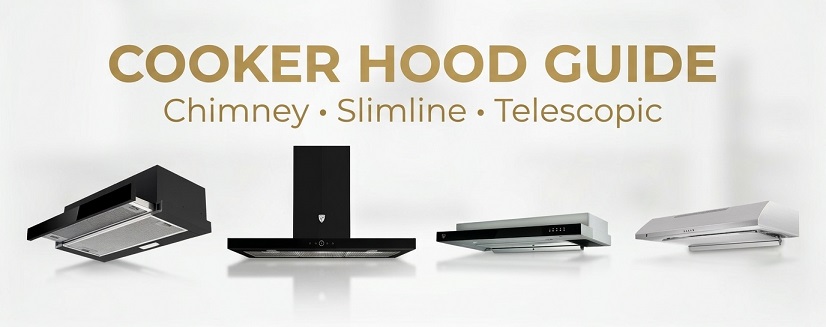
In Singapore, cooker hoods are mainly either chimney hoods, which are wall-mounted, or built-in hoods (the slimline and telescopic styles), which integrate into the cabinet above your counter. Island hoods are used for island kitchens.
Chimney hood
A chimney hood is the tall, wall-mounted type that sits above the hob, with a wider canopy over the cooking area and a chimney-style cover extending upwards. Chimney hoods are for wall mounting only.
Best for: a wall-mounted hob where you want a prominent hood with good coverage. A chimney hood can also become a feature in an open-concept kitchen. Check your available wall space and the position of your hob first.
Slimline hood (built-in)
A slimline hood has a slim, compact body that sits flush and is usually built into the cabinet above the counter.
Best for: kitchens that have an overhead cabinet and want the hood to blend in neatly. Make sure it still gives enough coverage for your cooking, particularly if you regularly use a wok.
Telescopic (pull-out) hood (built-in)
A telescopic hood, also called a pull-out hood, is built into the overhead cabinet and can be pulled out when you cook and pushed back when you are done.
Best for: kitchens with an overhead cabinet where you want the hood tucked away when not in use. Pulling it out during cooking extends the capture area over the hob.
Island hood
An island hood is installed above a hob on a kitchen island rather than against a wall, and is mounted from the ceiling.
Best for: larger kitchens with an island cooking area. Because there is no wall behind the hob, the hood needs good coverage, and installation is more involved.
How much suction power do you need?
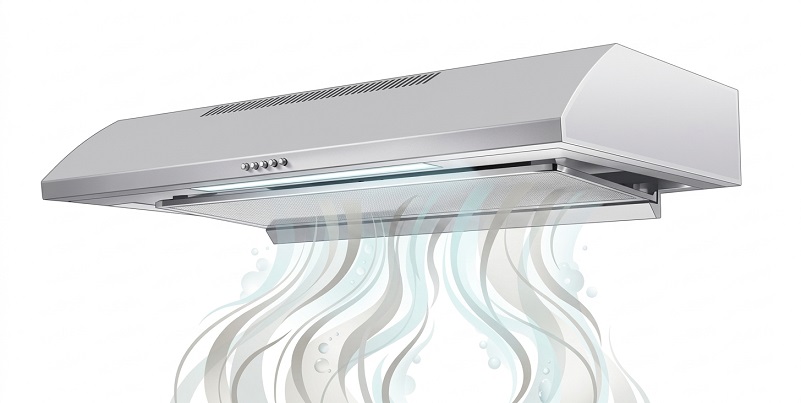
Suction power is stated in m³/hr (cubic metres of air moved per hour). As a rough guide for Singapore kitchens:
- Average suction (about 400 to 450 m³/hr): fine for lighter, everyday cooking.
- Medium suction (about 550 to 650 m³/hr): better for regular stir-frying.
- High suction (about 750 to 1000 m³/hr): best for heavy wok cooking and frying.
Choose based on how you actually cook, not on the biggest number. More suction does not automatically mean better performance, the hood's design, filter and coverage over the hob all affect how well it captures fumes.
Recirculating vs ducted: what most Singapore homes use
For Singapore homes this is simpler than it first looks: the great majority of residential cooker hoods are the recirculating type.
Recirculating (the usual choice for homes)
A recirculating hood draws air through a grease filter and then a charcoal filter, and returns the filtered air back into the kitchen. It does not need external ducting, which is why it suits HDB and condominium kitchens. The charcoal filter reduces cooking smells and needs replacing from time to time.
Ducted (mainly commercial)
A ducted hood sends the extracted air outside through a duct. In Singapore this is generally used in commercial kitchens such as coffee shops, restaurants and hawker centres, where external ducting is available. It is not the typical setup for a home kitchen.
So for most homeowners, a recirculating hood is the practical, standard choice.
Match the hood width to your hob
Your cooker hood should provide good coverage over the cooking area, and it should never be narrower than the hob underneath it.
In Singapore, cooker hoods, whether chimney or built-in, mainly come in two widths: 600mm and 900mm. A simple way to choose:
- 600mm hood: use it when your hob is up to 600mm wide.
- 900mm hood: use it for a wider hob, up to the usual 86cm maximum hob width.
Choosing a hood at least as wide as your hob helps capture fumes that rise and spread sideways during wok cooking. Also check the hood's dimensions against your cabinets and wall space so it sits in a suitable position above the hob.
Filters: aluminium grease, tray and charcoal
Filters keep your hood working well and are part of everyday maintenance. Locally you will mainly come across these:
Aluminium grease filter
Layers of fine aluminium mesh that trap grease from the extracted air. It can be removed and washed, and regular cleaning is important because trapped grease affects airflow over time.
Tray filter
A grease tray, usually held in place by magnets, that you can conveniently lower to clean and slot back. It is a practical, easy-to-maintain option for busy kitchens.
Charcoal filter
Used in recirculating hoods, the charcoal filter has one job: to remove cooking smells before the filtered air returns to the kitchen. Charcoal filters cannot be washed, they need to be replaced according to the manufacturer's recommendations.
What about auto-clean?
Some cooker hoods have an auto-clean or self-cleaning function to help deal with grease inside the hood. This can be handy for households that fry and wok-cook often.
Auto-clean does not mean zero maintenance, though. The outer surfaces and grease filters still need regular cleaning, and any charcoal filter still needs replacing. Think of auto-clean as a helpful aid, not a hands-off system.
A note on noise
Be realistic about noise: most suction hoods run at broadly similar noise levels. The main thing to expect is that the higher the suction setting, the more noise the hood makes.
So if you often cook on high heat and use strong suction, expect more sound at that setting. That is normal across hoods, not a sign of a fault. In an open-plan kitchen that connects to the living or dining area, just keep in mind that the hood will be more noticeable on its highest speed.
Cooker hood types compared
| Hood type | Best for | Main advantage | Consideration |
|---|---|---|---|
| Chimney | Wall-mounted hob | Strong presence and broad canopy | Wall-mounted only, needs wall space |
| Slimline (built-in) | Kitchen with an overhead cabinet | Slim, blends into the cabinet | Check coverage for heavy cooking |
| Telescopic (built-in) | Overhead cabinet, tucked away | Pulls out over the hob when cooking | Needs a suitable top cabinet |
| Island | Island cooking area | Made for island layouts | Ceiling installation, larger kitchens |
FAQ
What suction power should I look for in a cooker hood in Singapore?
As a rough guide, around 400 to 450 m³/hr suits lighter cooking, 550 to 650 m³/hr suits regular stir-frying, and 750 to 1000 m³/hr suits heavy wok cooking and frying. Consider the figure together with the hood's design, filter and coverage over the hob.
Do Singapore homes use ducted or recirculating hoods?
Most homes use recirculating hoods, which filter the air and return it to the kitchen with no external ducting. Ducted hoods are generally for commercial kitchens such as coffee shops, restaurants and hawker centres.
What size cooker hood should I get?
Hoods mainly come in 600mm and 900mm. Use a 600mm hood for a hob up to 600mm wide, and a 900mm hood for a wider hob (up to the 86cm maximum). The hood should never be narrower than the hob.
Do charcoal filters need to be replaced?
Yes. Charcoal filters used in recirculating hoods cannot be washed, they are replaced according to the manufacturer's recommendations, and how often depends on the hood and how much you cook.
Final thoughts
Choosing a cooker hood in Singapore is mainly about matching the hood to your kitchen layout and how you cook. A chimney hood suits a wall-mounted hob, while slimline and telescopic hoods are built-in choices for kitchens with an overhead cabinet. Island hoods are made for island cooking.
For heavy wok cooking and frying, pay attention to suction power and grease filtration, and match the hood width (600mm or 900mm) to your hob. For most homes, a recirculating hood is the standard, practical choice.
Ready to choose? Browse our cooker hoods, pair one with a matching cooker hob, or save with a hob and hood package. Deciding between gas and induction? Read our guide: Gas Hob vs Induction Hob in Singapore.
Related guides: How to Choose a Cooker Hob · Gas Hob vs Induction Hob.

Product tips and buying guides from the SG Appliances team.